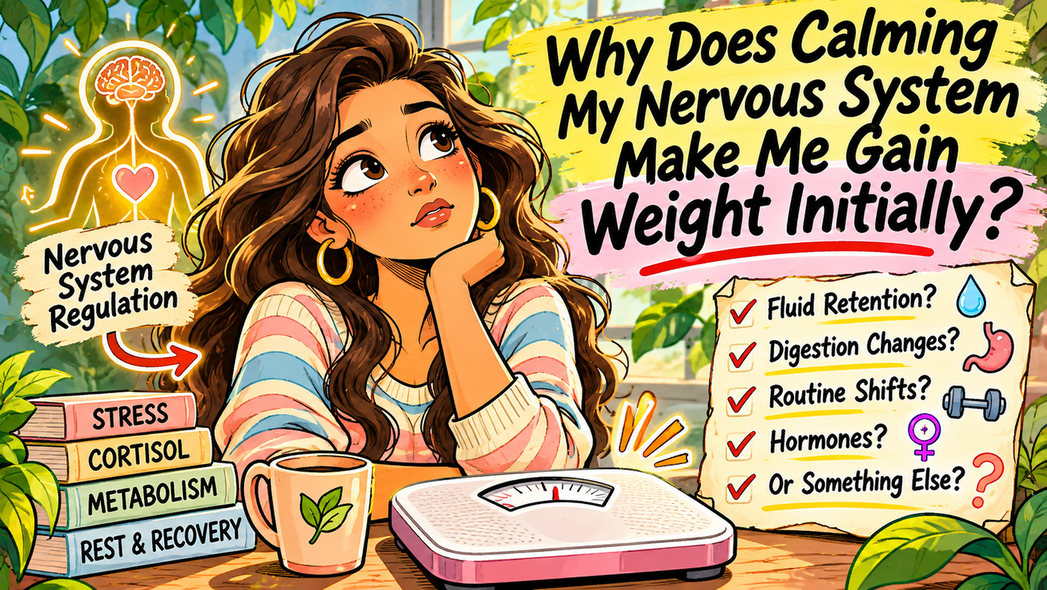
You’ve started doing something good for yourself.
Maybe you’ve swapped an exhausting workout for a gentle walk. Perhaps you’ve begun practising slow breathing, spending more time resting, or exploring somatic exercises to help your body feel less tense.
Then, a few mornings later, you step onto the scales.
The number has gone up.
It’s frustrating, especially when you’ve been making an effort to feel healthier. You might even wonder whether all this nervous-system work is somehow making things worse.

But does calming your nervous system actually cause weight gain?
There’s no convincing evidence that nervous-system regulation automatically causes an initial period of weight gain. If your weight increases after starting relaxation or somatic practices, the timing may be coincidental. Ordinary fluid fluctuations, digestion, changes in activity, eating patterns, medication or hormonal changes may explain what you’re seeing.
And one higher reading doesn’t necessarily mean you’ve gained body fat.
Affiliate disclosure: This article contains an affiliate link. If you purchase through it, MY HEALING SHIFT may earn a commission at no additional cost to you.
Why Your Weight Might Increase When You Start Relaxing More
When you’re trying to understand a change in your body, it’s tempting to look at the newest thing you’ve introduced.
Started breathwork on Monday. Weight went up on Thursday. Therefore, the breathwork must be responsible.
It’s an understandable connection to make. But two things happening close together doesn’t establish that one caused the other.
Your body weight changes all the time, even when your body fat doesn’t.
1. Water retention can change the number on the scales
Your body constantly adjusts how much water it retains and releases.
A salty meal, a change in carbohydrate intake, hormonal fluctuations or certain medications can temporarily increase fluid retention.
According to Cleveland Clinic’s explanation of everyday weight fluctuations, changes of several pounds can occur over a short period without representing equivalent changes in body fat.
So, if you’ve gained a pound or two since starting your relaxation routine, it doesn’t automatically mean you’ve gained that amount of fat.
It may simply be water.
2. Your digestion may be affecting the reading
Think about what happens between eating dinner and your next trip to the bathroom.
Food and fluid move through your digestive system at different rates. The amount of material currently in your stomach and intestines contributes to your total body weight.
Constipation can also make the number on the scales rise temporarily.
The autonomic nervous system helps regulate digestive activity, but that doesn’t mean breathing exercises reliably cause constipation, improved digestion or weight gain.
If your eating habits or bowel movements have changed recently, they’re worth considering before attributing the increase to your nervous-system practice.
3. Your routine may have changed more than you realise
Sometimes, working on nervous-system regulation means changing several habits at once.
You might be sleeping longer, exercising less intensely, eating more regularly or recovering from a period of illness or significant stress.
Some of those changes can affect your energy intake, energy expenditure or fluid balance.
For example, if you’ve been undereating during a stressful period and have begun eating more consistently, your weight may change as your intake changes.
The National Institute of Diabetes and Digestive and Kidney Diseases explains that body weight is influenced by several interacting factors, including sleep, medications, health conditions, activity and eating habits.
That isn’t proof of a special nervous-system healing phase. It may reflect an understandable shift in your routine.
And if you’ve been pushing through exhaustion for months, the benefits of getting adequate rest shouldn’t be judged by one number on the scales.
<
Does the Parasympathetic Nervous System Make You Gain Weight?
You’ve probably heard the parasympathetic nervous system described as your body’s rest-and-digest system.
That’s a useful shorthand, although the autonomic nervous system is more complicated than a simple switch between stress and relaxation.
Its parasympathetic pathways help regulate functions including heart rate and aspects of digestion. Sympathetic pathways also contribute to normal physiological regulation, particularly when your body needs to respond to changing demands.
But here’s where some online explanations become misleading.
You may come across claims that moving out of survival mode causes the body to hold water, slow its metabolism or temporarily gain weight because it finally feels safe.
These explanations can sound convincing, especially if you’ve experienced both chronic stress and unexplained weight changes.
However, a predictable parasympathetic rebound weight-gain phase hasn’t been established in clinical research.
The relationship between stress, appetite, metabolism, physical activity and body weight is complex. It varies considerably between individuals.
So, rather than assuming your nervous system is causing the increase, it’s more useful to look at the full picture.
What About Cortisol, Stress and Belly Fat?
Cortisol is often blamed for almost every frustrating change in body weight.
It’s certainly involved in the body’s stress response. It also helps regulate metabolism and other essential functions.
But cortisol isn’t simply a bad hormone that needs to be switched off.
Stress can influence appetite, sleep, eating behaviour and activity levels. For some people, prolonged stress is associated with weight gain. Others experience reduced appetite or weight loss.
The National Institutes of Health’s overview of weight-related factors discusses the roles of stress, sleep, medical conditions and medications in weight regulation.
It’s also important to distinguish everyday stress from medical conditions involving abnormal cortisol production.
If you’re concerned about persistent changes in weight, especially alongside other unexplained symptoms, a healthcare professional can help investigate possible causes.
Can reducing stress help with weight management?
It may help indirectly.
If feeling calmer improves your sleep, makes emotional eating easier to recognise or allows you to develop a more sustainable relationship with exercise, those changes may support your overall health.
But stress reduction isn’t a guaranteed weight-loss treatment.
You can practise nervous-system regulation because you want to feel less overwhelmed, sleep more comfortably or respond to difficult emotions differently.
Those are worthwhile reasons in their own right.
And they don’t disappear because the scales went up on Thursday.
Related reading: Nervous System Regulation for Stubborn Weight Loss: Why Survival Mode Stalls Your Metabolism. This companion article explores the relationship between stress responses and weight management.
How to Tell Whether You’ve Gained Fat or Your Weight Is Simply Fluctuating
One measurement gives you very little context.

Imagine weighing yourself on a Monday morning before breakfast, then again on Wednesday evening after dinner.
Those two readings aren’t directly comparable.
Even when you weigh yourself under similar conditions, normal fluctuations can still occur.
As Cleveland Clinic explains in its guidance on weighing yourself, consistency and longer-term patterns are generally more informative than reacting to individual readings.
If monitoring your weight is useful and doesn’t increase anxiety, consider looking at patterns over several weeks rather than reacting to a single number.
You might also notice whether:
- You’ve recently eaten more salty foods or changed your carbohydrate intake.
- Your menstrual cycle could be affecting fluid retention.
- You’re constipated or experiencing digestive changes.
- You’ve started or changed a medication.
- Your exercise, sleep or eating routine has changed.
These observations aren’t a diagnosis. They’re simply ways to put the number into context.
If weighing yourself makes you increasingly distressed, taking a break from the scales may be more helpful than collecting additional measurements.
A Gentle Three-Minute Somatic Reset When the Scales Trigger Anxiety
Sometimes the hardest part of an unexpected weight change isn’t the number itself.
It’s what happens afterwards.
You notice the increase, your thoughts start racing, and suddenly you’re questioning your food choices, your exercise routine and whether your body can be trusted.
Before making any decisions about changing your routine, try giving yourself three minutes to settle.
This exercise isn’t intended to reduce body fat, remove retained fluid or manipulate your vagus nerve. It’s a simple grounding practice that may help you respond more calmly.
Minute 1: Notice where you are
Sit somewhere comfortable, with your feet supported if possible.
Look around the room.
Notice a few ordinary details: the colour of a wall, the shape of a window, or the feeling of the chair beneath you.
There’s no need to close your eyes.
The purpose is to shift some of your attention away from the worrying thought and towards your immediate surroundings.
Minute 2: Let your breathing become comfortable
Notice your breathing without trying to force it into a particular rhythm.
If it feels pleasant, allow your exhalation to become slightly slower.
Don’t hold your breath or push for unusually deep breaths.
If focusing on breathing makes you uncomfortable, return your attention to the room or the contact of your feet with the floor.
Minute 3: Ask yourself one useful question
Instead of asking, Why is my body doing this to me?, try:
What do I actually know about this weight change?
Perhaps you know you’ve slept poorly. Maybe you ate a salty dinner. Perhaps you’re approaching your period.
Or maybe you simply don’t know yet.
That’s an acceptable answer.

You don’t need to explain every fluctuation immediately, and you don’t need to punish yourself for one unexpected measurement.
Can Somatic Practices Help You Develop a Better Relationship With Your Body?
Somatic approaches often encourage paying attention to bodily sensations, movement and how you respond to stress.
For some people, this can provide a different way of noticing tension, discomfort or emotional reactions.
It might help you recognise when you’re becoming overwhelmed or when a particular activity feels too demanding.
However, not every body sensation has an emotional cause, and bodily awareness doesn’t replace medical assessment.
A tight stomach might accompany anxiety, for example, but persistent abdominal symptoms can also have gastrointestinal or other medical explanations.
The most useful approach is one that makes room for both possibilities.
Exploring somatic body awareness
If you’re interested in learning more about body-oriented approaches, Peter A. Levine’s Body as Healer programme introduces somatic practices focused on pain and bodily experience.
It may be relevant if you’re exploring how you relate to physical sensations and stress, rather than looking for a weight-loss programme.
When Should You Seek Medical Advice About Unexpected Weight Gain?
Small, short-term fluctuations are common.
But persistent or unexplained weight gain deserves attention, particularly if it’s substantial or accompanied by other symptoms.
The MedlinePlus guide to unintentional weight gain describes possible causes including medication effects, hormonal changes and medical conditions that can lead to fluid accumulation.
Speak with a qualified healthcare professional if you notice continuing changes that don’t have an obvious explanation.
Seek prompt medical advice if weight gain occurs rapidly alongside new swelling, particularly in your legs or abdomen. Sudden breathlessness, chest pain or severe breathing difficulties require urgent medical attention.
You don’t have to choose between caring for your nervous system and seeking medical answers. Both can be part of looking after your health.
Frequently Asked Questions
Can nervous-system regulation cause temporary weight gain?
There’s no established evidence that nervous-system regulation itself causes a predictable period of temporary weight gain. Changes in fluid balance, digestion, eating patterns, medication or activity may explain fluctuations occurring around the same time.
Does activating the parasympathetic nervous system slow metabolism?
The parasympathetic nervous system helps regulate resting functions, but this doesn’t mean relaxation exercises automatically slow your metabolism or cause fat gain. Energy balance and metabolic regulation involve many interacting processes.
Why am I gaining weight even though I feel less stressed?
Feeling less stressed doesn’t guarantee weight loss. Weight changes may reflect fluid retention, dietary changes, activity levels, hormonal factors, medication or other health conditions.
Can somatic exercises help with weight loss?
Somatic exercises may be useful for body awareness and managing stress, but there’s insufficient evidence to recommend them as a direct weight-loss treatment. Their benefits should be evaluated separately from changes on the scales.
How long does initial nervous-system weight gain last?
There is no medically established initial nervous-system weight-gain phase, so there’s no evidence-based duration. Ordinary weight fluctuations may resolve over days, while sustained or unexplained changes warrant further assessment.
A Final Thought About Your Body and the Scales
If you’ve started making space for rest after a long period of stress, an unexpected weight increase can feel particularly discouraging.
But one measurement doesn’t tell you whether your nervous system is becoming healthier, whether your habits are sustainable, or whether you’re making progress with emotional wellbeing.
Keep an eye on changes that genuinely need attention. Ask for medical guidance when something seems unusual.
And allow your calming practices to serve a purpose beyond changing your weight.
Medical disclaimer: This article provides general educational information and is not a medical diagnosis or personalised treatment plan. Nervous-system symptoms and weight changes can have multiple causes. Consult an appropriately qualified healthcare professional about persistent, rapid or concerning changes. Somatic exercises and relaxation practices are not substitutes for medical care.
Leave a Reply