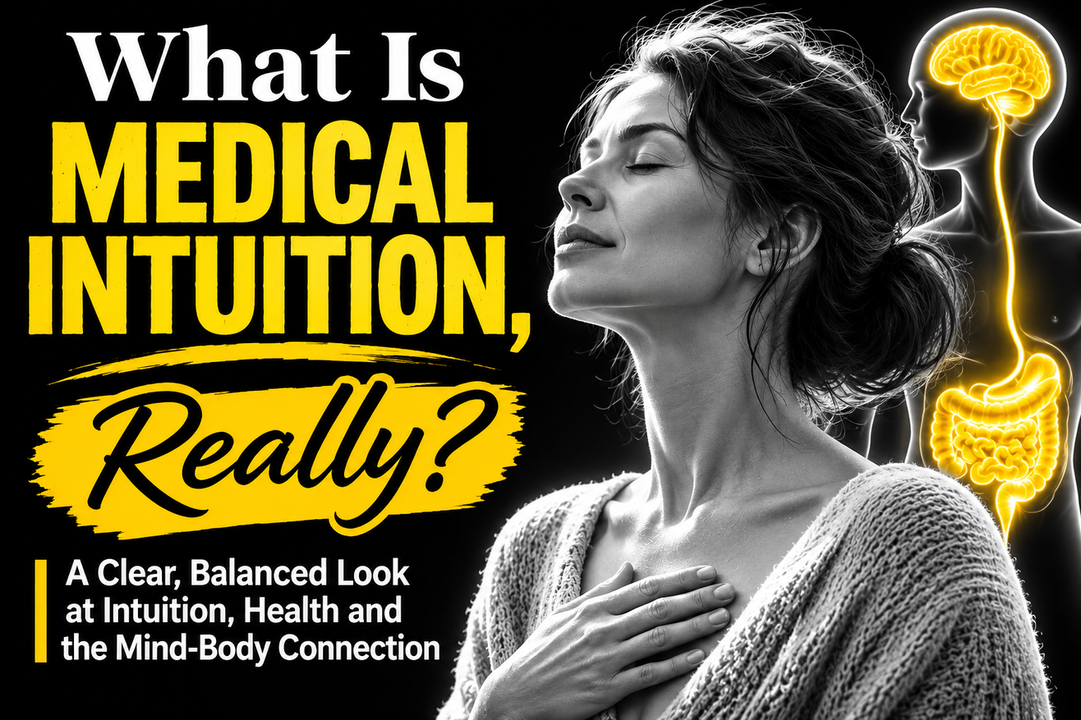
You notice a familiar tightness in your shoulders before a difficult conversation. Your stomach feels unsettled when you’re worried about something. Or perhaps you’ve had a strong feeling about a situation before you could explain why.
Experiences like these can make us curious about the relationship between our thoughts, emotions and bodies.
For some people, that curiosity leads to a subject called medical intuition.
But what does medical intuition actually mean? Is it another way of describing body awareness, a spiritual practice, or something that can tell us about our physical health?
The distinction matters, particularly when health claims enter the conversation.
Table of Contents
What Is Medical Intuition?
Medical intuition is a practice in which someone attempts to gain information about a person’s physical or emotional health through intuitive impressions rather than conventional medical examinations or tests.
Practitioners may describe receiving images, sensing energy, noticing symbolic associations or experiencing a strong inner impression about another person’s well-being.
Some approach it as a spiritual practice. Others describe it as a form of heightened sensitivity or intuitive awareness.
Medical intuition has not been scientifically established as a reliable method of diagnosing or treating illness.
That doesn’t prevent someone from exploring the subject as a spiritual or personal interest. It does mean that intuitive impressions shouldn’t be treated as medical findings.
How Is Medical Intuition Different from Body Awareness?
It’s easy to confuse these two ideas because both involve paying attention to what we experience.
Body awareness means noticing physical sensations, such as breathing, muscle tension, temperature, heartbeat or discomfort.
You might notice that your jaw is clenched while you’re working, for example, or that your breathing becomes quicker when you’re nervous.
These observations can be useful because they help you recognise what’s happening in the present moment.
Medical intuition goes further. It involves interpreting impressions, sensations or symbolic experiences as information about health, sometimes without the usual medical evidence needed to support those interpretations.
That additional step is where we need to be careful.
Noticing tension in your shoulders is an observation. Deciding that the tension proves you have a particular emotional blockage or medical condition is an interpretation.
The first may be directly observable. The second requires evidence that the sensation alone cannot provide.
Where Does Caroline Myss Fit In?
Caroline Myss is a five-time New York Times bestselling author whose work explores spirituality, intuition, personal beliefs and the relationship between emotional experiences and health.
Her teachings have helped popularise the idea of medical intuition among people interested in spiritual and complementary approaches to well-being.
Working with the late neurosurgeon Dr Norman Shealy, Myss developed educational material exploring intuition, symbolism, energy systems and spiritual interpretations of healing.
In her approach, intuitive awareness is presented as something people can explore and develop, rather than simply a mysterious ability possessed by a select few.
Her teachings also consider how personal choices, beliefs and patterns of behaviour might influence the way people understand their lives.
These ideas may encourage reflection, but they should not be confused with scientifically demonstrated explanations for the causes of illness.
Can Emotions Affect the Body?
Yes. Emotions and stress can influence physical processes.
Think about what happens when you’re suddenly frightened. Your heart may beat faster, your breathing may change and your muscles may tense.
A difficult day can also leave you feeling physically tired or restless.
These are examples of how psychological experiences and bodily responses interact.
But recognising these connections doesn’t mean that every illness has an emotional cause.
A headache might occur alongside stress, but headaches can have many possible causes. Persistent fatigue might coincide with emotional strain, but it can also be associated with sleep difficulties, medication effects or medical conditions.
The relationship between emotional well-being and physical health is real and complex. It cannot be reduced to a simple rule that particular feelings create particular diseases.
And experiencing illness does not mean someone has failed to think positively, release an emotion or develop sufficient self-awareness.
What Does Science Say About Medical Intuition?
This is where curiosity needs to be accompanied by careful evaluation.
Some research has explored medical intuition. For example, a published exploratory study involving 67 participants reported favourable subjective assessments of intuitive readings.
However, participants’ perceptions that a reading was accurate are not equivalent to demonstrating reliable medical diagnostic performance against independently verified clinical findings.
Small exploratory studies can raise questions for future research. They cannot, by themselves, establish that a practice works as a diagnostic method.
At present, medical intuition has not been established through robust clinical evidence as a reliable way to diagnose disease or determine treatment.
That distinction is especially important when a practitioner claims to identify an illness, a hidden physical problem or an underlying emotional cause without medical testing.
A compelling personal experience can feel meaningful without proving that the explanation attached to it is medically correct.
Why Are People Interested in Medical Intuition?
People come to the subject for different reasons.
Some are interested in spirituality and the possibility that intuition plays a larger role in their lives than they previously realised.
Others want to understand how their beliefs and emotional experiences affect their sense of well-being.
And some simply enjoy exploring unfamiliar perspectives.
There is nothing wrong with asking questions about your inner life.
The difficulty begins when an interesting idea is presented as a medical certainty, particularly if it discourages someone from seeking appropriate care.
You can find a spiritual teaching thought-provoking without accepting every claim made within it.
Can You Explore Intuition Without Using It to Diagnose Yourself?
Absolutely.
A useful starting point is to become more attentive to ordinary experiences without immediately assigning them a hidden meaning.
You might try sitting quietly for a moment and noticing your breathing, the position of your shoulders or how your body feels after a busy day.
Then ask yourself a simple question:
What am I noticing right now, and what do I actually know about it?
Perhaps you’re feeling tense. Perhaps you’re tired. Perhaps you don’t know why you feel a particular way.
It’s perfectly reasonable not to have an immediate explanation.
You can reflect on those experiences, make notes or discuss them with someone you trust.
And if a symptom is persistent, unusual or concerning, seek advice from a qualified healthcare professional rather than trying to interpret it through intuition alone.
Exploring Caroline Myss’s Medical Intuition Teachings
If you’re curious about how Caroline Myss presents these ideas herself, Sounds True offers a free introductory three-video series called The Science of Medical Intuition.
The videos explore:
- What medical intuition is, including how Myss believes it relates to health and healing.
- Why people don’t heal, examining obstacles to healing within her spiritual framework.
- Five keys to developing intuition, introducing ideas from her approach to intuitive awareness.
The series gives you an opportunity to hear her perspective directly and decide what you think.
You don’t have to accept the teachings as scientific fact to listen with interest.
Explore the Free Three-Video Medical Intuition Series
This link takes you to our independent MY HEALING SHIFT guide, which explains the free Sounds True series and includes an affiliate link. Registration takes place on Sounds True, where you’ll be asked for your first name and email address and will consent to receive their email communications.
A Final Thought: Curiosity and Good Judgment Can Coexist
Learning to notice your emotions, thoughts and physical sensations can be a useful part of understanding yourself.
Medical intuition introduces a further spiritual interpretation of those experiences. You may find aspects of that interpretation interesting, unfamiliar or difficult to accept.
There’s room for all three responses.
What matters is maintaining the distinction between something that feels personally meaningful and something that has been established as medically reliable.
You can explore spiritual ideas while still asking for evidence, seeking professional healthcare when needed and allowing yourself to say, I don’t know.
Sometimes that’s the most useful place to begin.
Medical information disclaimer: This article is for educational purposes only and is not medical advice. Medical intuition is not a validated method of medical diagnosis or treatment. Consult a qualified healthcare professional about persistent, unexplained or concerning symptoms.
Affiliate disclosure: MY HEALING SHIFT may earn a commission from qualifying purchases made through affiliate links on the linked course information page, at no additional cost to you.